Showing posts with label HIV/AIDS. Show all posts

Thursday, November 30, 2006

World AIDS Day and VCT. What are you doing where you are to fight this pandemic?

Tomorrow I will be going with Ben, Douglas and an outside counselor to do VCT (volunteer, counseling and testing) with a government department in Pretoria as the start of a week long VCT campaign kickoff on the 25th World AIDS Day. I will not be counseling but rather helping the other three with logistics and ensuring that the process runs smoothly. We will be using a test that doesn’t require drawing blood (unless one tests positive for HIV) but instead requires putting a testing device with a swab on the end in your mouth to get saliva which can be tested for HIV. If one is unfortunate to test positive then we use a disposable needle to prick the finger and a confirmatory test to see if they are really positive. If it comes up negative we do a third test and if this is inconclusive we let them know where they can find a clinic to be tested. The tests are supposed to be basically full proof so the results should be correct.

We will only have each person use the swab to test their saliva after someone who is positive gives a talk about “living positively” and Douglas follows this with the beginnings of a counseling session. This will be to a group of upwards of 200 people if possible. The larger the group the better (as more people can choose to know their status) but we will only be able to see about 30 people total tomorrow as counseling can take up to 45 minutes per person if not more if they are positive or require more attention. Then this coming week Doug, Linzi and Ben will be going back to Pretoria to continue counseling the people who will do VCT tomorrow and others who will come to do it. They don’t get their results until they have been counseled and often the counseling that comes after finding out of they are positive or negative is the most important. Positive people need to know how to continue to live a long and healthy life, not infect others and disclose (if they chose to) to their families, friends, partners, etc. Negative people need to know how to stay negative and not get the idea that they are invincible but must practice safe sex or better yet abstain as it is the best way to remain negative.

It will be an interesting way to pass the celebration of a quarter century of HIV/AIDS. I guess that sounds a bit strange but what people need to come to realize is that World AIDS Day is everyday as everyday thousands of people around the world die from AIDS related diseases and thousands more get infected or infect others. Here in South Africa between 900 and 1,000 mothers, fathers, daughters, sons, sisters, brothers, etc. die from AIDS related diseases. We must not just try to plug up the dykes keeping HIV from infecting or affecting all persons but really react quickly, comprehensively and smartly to this pandemic. Please join me today, tomorrow and until we defeat AIDS to do what you can where you are to combat this ferocious enemy. If we are not part of the solution then we are part of the problem.

Saturday, September 23, 2006

More Topsy tots…

Just wanted to share some more pics from my time at the Topsy Foundation with you all. As you can see Topsy gets much of its funding from various private organizations that donate funds and materials.


Here is Topsy’s main building which houses the crèche, dormitories, sewing shop, kitchen and more.


Monday through Friday the kids have chances after dinner to do art. The art time is led by the volunteers or staff if no volunteers are available. The children get to paint, make masks, draw, make envelopes and write letters and more. For those who don’t recognize it this child was making a mask that resembles the South African flag.


The boys and girls live in dorms sometimes four to a room, in this case eight or more live in this room. They normally have wooden bunk beds, thin mattresses and blankets to cover themselves with. 36 kids ages 2 to 17 live at Topsy and they could take many more as they have the staff, infrastructure and money to do so but this is the limit that the government has placed on them.


Beads used to make key rings, bracelets, necklaces and more as part of the bead making project. Some of the 30 women involved in this project work from home as they live to far or have some other reason to work from home.


If you go to http://www.topsy.org.za/community/index.htm you can see more pictures and learn more about the various projects that Topsy does to bring in money and train locals people in a variety of skills.


One of the seamstresses who works on one of the other income generating and skills building activities that Topsy created and supervises. This project is particularly good as two of the six people who work on it work most of the time making clothing for the kids who live at Topsy and the children who come to study at the crèche. It is a nice cyclical project in this way as jobs are provided to people in need and in turn they make clothing for less fortunate children so that they can go to school, etc. They also make some clothing for sale as well as handbags, quilts and more.


Ironing some of the newly cut materials being used to make a dress for one of the Topsy kids. I spent about 90 minutes talking with the six women working in the sewing project asking them about how long they have been with Topsy, what work they did before, about their families and more.


One of the dresses made for sale by the Topsy seamstresses. They take orders so if any of you who are in the States who I will be seeing next spring or summer are interested let me know and I can see about getting something made for you. They also do nice men’s shirts as well. The same goes for the beads that are being made I could buy some for anyone who is interested and you can pay me back upon delivery.

Who could forget Madiba bags to go along with the dresses and shirts made out of cloth with the image of this iconic figure of grace, forgiveness and persaverance.

A lot of interesting and innovative art adorns the walls at Topsy donated by various artists. It is a good way to recycle various used materials, making something that looks pleasing and bring in money.

If I could own this piece and fit it into my suitcase I would love to take it home. I think the photograph is great and the contrast with the metal is really original.

Someone’s has to be in charge of cooking for the staff, caregivers, volunteers and kids and there is a nice kitchen crew in charge of this and they do a good job with the food that they can afford. Some of it is grown in community gardens that Topsy has and if I am able to visit again I hope to see these gardens. Part of the agreement is that people who Topsy gives food to have to also be growing food in their own gardens similar in a way to what Heifer International does with cows, goats, etc.


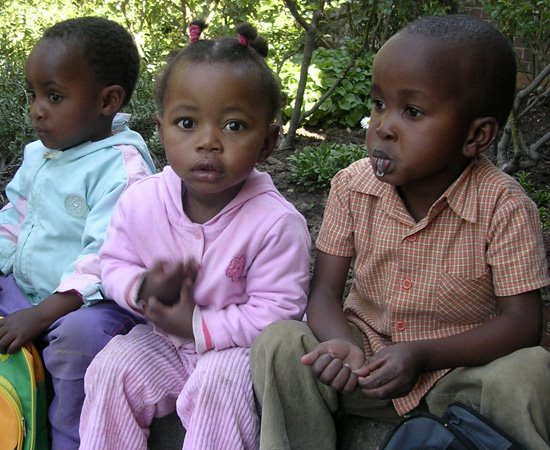
No words are necessary to explain this other than to say that these little ones were waiting for the Topsy transport to take them home.


Nicely situated inside the back of this truck, without seatbelts but at least with a top, this boy gave me a last smile before the truck pulled away.


As always any photos with me come at the end so that if you are looking at this blog to see me you have to go through all that comes before to get your reward. As I mentioned before I would love to go back to Topsy and stay for a longer time maybe a week if I can get more time off of work so as to see the gardens, go out with the field staff and do home based care visits, play with more of the kids, etc. Maybe I could even teach a little with the older kids.

Friday, September 22, 2006

Babies, birthdays, beads, boys and girls.

Jennifer, one of the volunteers, plays with a crèche child during their recess. The kids are blessed with an extensive play structure including ladders, bridges, swings and much more. It was similar to an obstacle course used at camps or by the military but kiddie sized and more fun.

Topsy logo and website address on one of thevehicles in Topsy's fleet. They use their trucks, buses and vans for a variety of activities including transporting cr
èche kids, bringing patients to see the social workers, nurse and doctor to receive ARVS (anti-retroviral drugs), business trips and much more.


These crèche cuties couldn't resist the camera and really wanted to inch closer and closer and I and so I had to motion for them to stand back on the suspension bridge and smile for the pic.


This is one of the many halls in Topsy's Rufford House which is one of the buildings left over by an old coal mine that was in Grootvlei, the town where Topsy's sanctuary is located. At the sanctuary there are 36 children who live at the sanctuary which I referred to in my last blog as an orphanage. While some of the children are orphans and many have lost one or both of their parents to HIV, not all are orphans but are there for a variety of reasons.


One of the income generating projects that Topsy sponsors and manages is with 30 women from the surrounding area that are taught how to make various bracelets, key rings, hair pins and more out of beads. I will show more pictures of this in my next blog but just wanted to give you a visual to see one of the ways in which Topsy trains skills to locals in need and fundraises for the plethora of activities that it is doing.


Last night it almost felt like a going away party for me after spending less than 36 hours at Topsy but the fun wasn't really for me in fact it was a birthday celebration for a few of the children. Each month they wait until the final child is celebrating his or her birthday to celebrate the birthdays of all the children. I am hoping to go back to Topsy at another point during my stay here as 1 1/2 days was not nearly enough and while I did a lot in this short amount of time there is much more I would like to do such as joining the field staff as they visit patients living with HIV/AIDS, work in Topsy sponsored community gardens and more.


Like always I keep any photos of me until the end and this one is special and this little girl whose name I know but will choose to exclude due to privacy became one of my best friends at Topsy in my short stay. Her younger sister is a real cutie too and she is the little one on the bridge above with the light blue soccer jersey and shorts and her older sister works at Topsy. There were a number of siblings staying at the sanctuary which must be good to support each other. I wasn't asked by Topsy not to share names or take photographs but I think that it is important to protect the rights of the staff and the children even though most of them will never even see this blog, etc.

Thursday, September 07, 2006

Training, T-Cells, tools and treats.

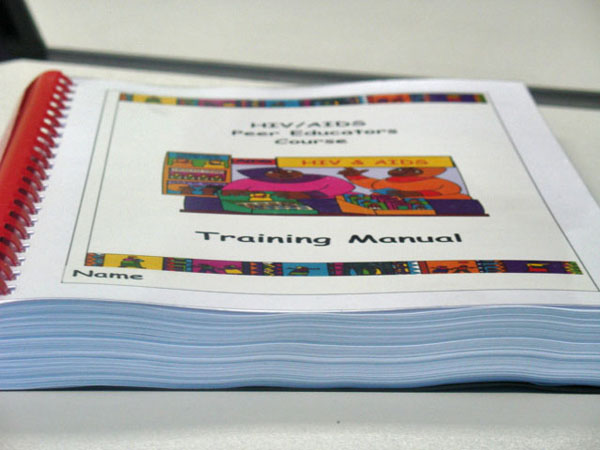
This is the main tool that we use during our Peer Educator Training. This manual was developed by Linzi. It has 12 modules covering everything on training HIV/AIDS from behavior change models to communication skills to epidemiology to condoms to myths and old wives tales. After they have finished the training the Peer Educators also get an "HIV/AIDS 36 Week Programme Course" that they use with their peers to educate them.
Here is Ben training the group that he worked with over the past two weeks at an automotive company in the area. We did a six day training in four days which meant that we had to cut out a lot of what we would normally do with the full six days. In fact we would prefer another day if possible to make sure everything is covered
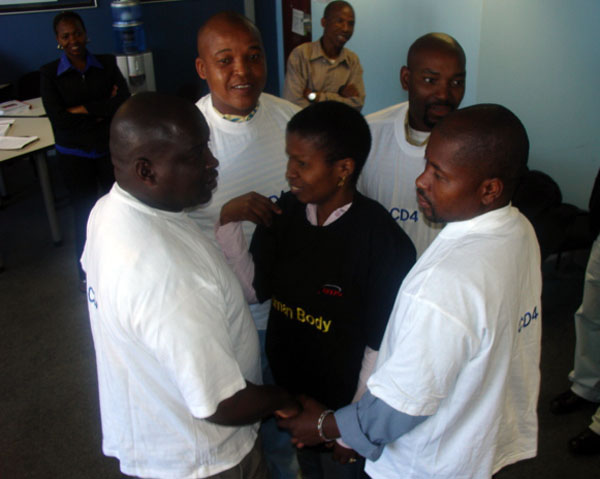
Here we have Douglas who had a group of his own. I worked mainly with Doug's group but also spent time with Ben's group so that when it came to training a module with them it was not as if I was walking in off the street for the first time. There were supposed to be 55-57 employees being trained as Peer Educators but over the four day training we saw maybe 35 of these people in all. The following few pictures were taken during the "CD4 Game" that we played with Ben's group. As you can see when the four CD4s were asked to protect the "human body" they first turned their backs to the outside and joined hands. We asked them how they would protect in this position, so......
....they turned towards the attackers but kept their hands linked and soon realized that to protect the body they would need to not hold hands.
This looks like a rugby or American football tackle here to keep Flu away from the human body. The game can get physical and even emotional as we play. This picture does some justice to the intensity of the game. It is a great way to get the blood flowing, drive away sleepiness and demonstrate for them how once HIV and AIDS has weakened the body diseases and viruses take advantage of the weakened immune system.
Here are two of our Peer Educators in training taking a break for treats and tea. It is funny to people that in addition to being a vegetarian I don't drink tea or coffee. I had similar experiences in Mozambique and even in the States.
Finally, we come upon a picture of me training with Doug's group. It was nice to finally get a chance to be facilitating various parts of the training. I will help some more in another training and then begin training on my own.

Saturday, September 02, 2006

Training in Tembisa and the CD4 Game.

This is a picture taken last Saturday by Marcilio when he and I were watching/participating in a training that Ben was leading for a church group in a schools assembly hall in Tembisa. To the right is Ben wearing a tie again and overseeing the CD4 Game. We hand out t-shirts with words on them such as Human Body, CD4 (the normal CD4 count for a person is between 800 and 1200 and for people with HIV and AIDS it drops over time and when it goes below 200 that individual has AIDS. It is at this point that one is advised if the have the access to and can afford to take antiretroviral drugs (ARVs)) TB (tuberculosis), STI (sexually transmitted infection), diarrhea, flu and other opportunistic diseases and infections. These diseases and infections can have minor or major effects to people without HIV and AIDS but can be deadly to those with HIV and AIDS. The idea is that the four people with CD4 t-shirts are asked to protect the human body and then when time passes and the CD4 cells begin to die off they leave the human body unprotected one by one. Eventually there are not enough CD4s to adequately protect the body and this is when people will die from a variety of diseases.

This is a game that we play during our peer educator trainings and did with this group as well. It is a good way to get people up and moving around and show them a visual representation of a concept that they are learning about. The group had 17 participants most in their late teens and early twenties and a few elders of the church too. It was a basic information and awareness session but the group hopes to invite us back to do a more complete training so that they can spread the "word" on HIV and AIDS throughout their congregation and community. It was also great for Marcilio to be able to attend and learn more about HIV and AIDS. He was very interested in the training and would like to learn more so he can do peer educator work in South Africa and Mozambique.

Thursday, August 31, 2006

Peer educators, behavior change and my first chance to facilitate a training.

I finally got a chance to lead part of a training while with Ben and Douglas at a multinational automotive company Tuesday and Wednesday. We spent both days training a group of 25-27 employees coming from various departments from the plant where we were training and another one about 40 kilometers away. We were supposed to have around 50 people to train as peer educators but for a variety of reasons ended up with a smaller group which is unfortunate as it means that less people will feel the impact of the training we were doing and will continue next week. Normally the peer educator training is done over a six day period with a seventh day for written exams, presentations and other activities to test the knowledge, confidence and ability of the peer educators so that they can receive certification before beginning their work as peer educators in their places of employment, communities, families and more. Our training will be done over four days with the fifth day being our exam and presentation day.

Peer educators are not just trained in HIV/AIDS (which is more properly referred to as HIV and AIDS so as not to further confuse and conflate the two as being one in the same) like we are doing at ETC but also trained to provide other information to their peers. The definition for peer educator that we use is “someone who is trained to inform his/her peers about a particular subject so that they can make informed decisions about the subject”. We focus mainly on HIV and AIDS, related diseases, the varied socio-economic conditions that people living with HIV/AIDS (PLWHA) find themselves in, how HIV and AIDS plays a role in the lives of those who are infected as well as affected by it and many more important topics related to HIV and AIDS.

The idea is for those that go through the peer educator training with us to share the information they have learned with their coworkers, families, churches, etc. and to be a positive influence for change in the lives of others. We don’t want them to keep this information to themselves or just better those in their close circle of friends and family but to be open and willing to share with anyone at anytime. A key distinction to make is that during this particular training we are not training peer counselors. We do offer a 10-15 day course for those who want to be trained as peer counselors but do not cover all the necessary skills for this in our peer educator course.

One of the biggest components of the training that we do and the work that these peer educators will be doing after being trained is behavior change. They first must go through a change in behavior (if they are still practicing unsafe sex, living a risky life, etc.) and then encourage the same in others. We are not out to change cultural or traditional practices (unless these create unsafe situations) but rather to get people to better realize the impact of the various decisions they make and be more responsible with their lives and the lives of others. It is important for each individual to take responsibility for their own actions and to see how what they do can and affect others. In a future blog I will discuss behavior change in more depth and detail as it is one of the components of the work that we do that I find the most interesting and crucial.

There are 12 modules plus the assessment (exams, presentation, etc.) that make up our peer educator training. I spent most of the time with Doug’s training group and near the end of the first day I began facilitating Module 3. This module includes defining health and disease, discussing the four components (bio, psycho, socio/spiritual) that make up the whole human being, discussing the nine foundations of health and talking about germs and how they get into the body. Due to limited time I wasn’t able to cover all of this at the end of the first day and thus concluded on Wednesday. The module took about 105 minutes from start to finish and went well considering that this was my first time training for ETC. I enjoyed participating in the training with the rest of those who were going through it but it was nice to finally be up in front leading discussions, sharing information and facilitating learning. I am looking forward to facilitating two or three other modules next week when we return for further training. I will definitely have more to share on this specific experience after next week.

A final thought is that it was good to have Doug there to lend support as my medical knowledge and history is very limited and thus certain questions were beyond my realm of experience and Doug was able to help. It is challenging and interesting to be involved in this work as a Christian Scientist but I think it can be rewarding as well. I will also return to this topic in future blog entries. Have a great weekend.

Thursday, July 20, 2006

My Job.

Although my job is still being defined and refined I can tell you a bit about the work that I will do in South Africa over the next six months. I am working with Linzi, Douglas and Ben as an HIV/AIDS consultant for ETC, Education, Training and Counselling which means I will be doing work around the office such as marketing and sales calls, grant writing and research and work in the field (factories, mines, government offices) such as training/facilitating HIV/AIDS

Peer Educator Courses, HIV Committee Development Programmes (I will be using British English for certain terms as that is the English primarily used here) and other knowledge, education and prevention trainings on HIV/AIDS.
I have already had a variety of experiences in my first few days including accompanying Doug on a sales call to a brewery looking to do some HIV/AIDS education with its employees and joined Linzi on a two-day HIV Committee Development Programme with 12 participants at a government office in Tshwane (formerly called Pretoria), which is South Africa’s national capitol and is located 63 kilometers (39 miles) from Joburg. Gauteng Province is one of nine provinces in South Africa is the smallest in terms of km²/mi² but has the second largest population with 8,837,172 about 600,000 people behind KwaZulu-Natal with 9,426,018 inhabitants (2001 Census). Gauteng Province is located in the Northeastern Region of RSA (Republic of South Africa) along with the province of Mpumalanga which is the province nearest to Mozambique and one I visited a few times while in Moz when I wanted to have time in RSA. I will share more about the countries geography, history, culture, etc. in later entries and now want to get back to the training.

Since this was my first time attending one of the many trainings that ETC offers I took this first chance to sit in with the participants and follow through the training manual as they were doing, participate in individual, small and large group activities. I also kept notes on Linzi’s facilitating with questions, compliments and suggestions as well as other questions about material covered, statistics, etc. I will leave you with this for now and return to this training at a later point to tell you more about the attitudes, perceptions, questions and ideas that the participants brought to the training and how these were addressed and hopefully corrected or clarified over the two day training.

http://rpc.technorati.com/rpc/ping