Showing posts with label peer educators. Show all posts

Sunday, November 19, 2006

First extended trip out of Joburg. Heading to the mines to do Peer Education, hang out with Ben and hopefully meet some Mozambicans!

In a few hours Ben will come pick me up to drive about two hours to the town of Orkney which is in the heart of a big mining operation in the North West Province. I was in Orkney with Ben a little over two weeks ago when we went to do the “CD4 Game” and have a booth at a mining exposition. I wrote a bit about the experience at the expo on Friday November 3rd. Ben has been going to Orkney for almost two years now to train and this will be his final trip for the year. Going to a mine to do training in HIV/AIDS has been own of my wishes with this practicum since before I came to South Africa. When Linzi told me about how ETC does training in mines, mainly training HIV/AIDS Peer Educators I was very interested and thus it is excited that in my final few weeks here I will get to spend time at one of the mines. I will do my best to run in to some Mozambicans to speak some Portuguese or Shangaana. I will definitely have many photos to share and stories to tell when I return late Friday. I might sneak into an internet cafĂ© during the week to post one or two entries but if that is not the case you will just have to wait till next Friday for more thoughts on my time here in South Africa.

Lest I forget, Freshly Ground put on a good show at the Bassline last night and I have many witnesses to testify to the fact that I did dance. Considering the fact that I don’t drink and thus don’t get rid of my inhibitions through alcohol and don’t come from a family of dancers I think I held my own and had fun regardless. There is another concert coming next weekend that I will try and go to if I can just find out the details of when and where.

Thursday, September 07, 2006

Training, T-Cells, tools and treats.

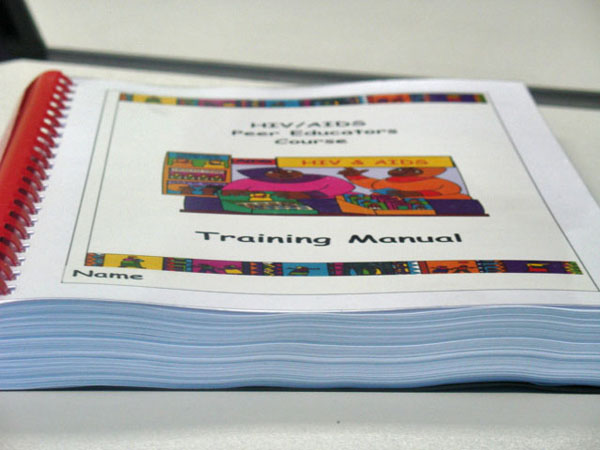
This is the main tool that we use during our Peer Educator Training. This manual was developed by Linzi. It has 12 modules covering everything on training HIV/AIDS from behavior change models to communication skills to epidemiology to condoms to myths and old wives tales. After they have finished the training the Peer Educators also get an "HIV/AIDS 36 Week Programme Course" that they use with their peers to educate them.
Here is Ben training the group that he worked with over the past two weeks at an automotive company in the area. We did a six day training in four days which meant that we had to cut out a lot of what we would normally do with the full six days. In fact we would prefer another day if possible to make sure everything is covered
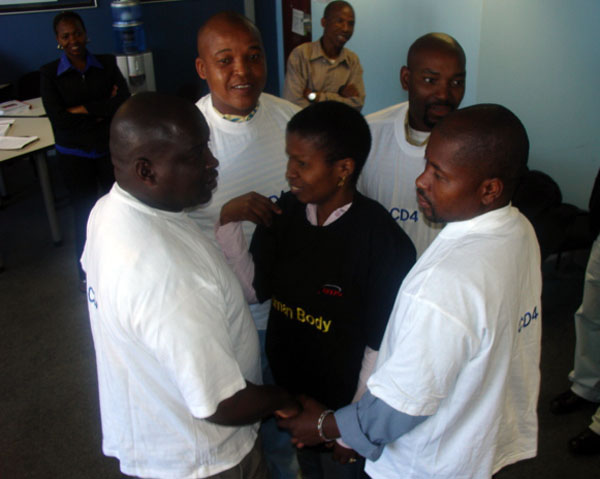
Here we have Douglas who had a group of his own. I worked mainly with Doug's group but also spent time with Ben's group so that when it came to training a module with them it was not as if I was walking in off the street for the first time. There were supposed to be 55-57 employees being trained as Peer Educators but over the four day training we saw maybe 35 of these people in all. The following few pictures were taken during the "CD4 Game" that we played with Ben's group. As you can see when the four CD4s were asked to protect the "human body" they first turned their backs to the outside and joined hands. We asked them how they would protect in this position, so......
....they turned towards the attackers but kept their hands linked and soon realized that to protect the body they would need to not hold hands.
This looks like a rugby or American football tackle here to keep Flu away from the human body. The game can get physical and even emotional as we play. This picture does some justice to the intensity of the game. It is a great way to get the blood flowing, drive away sleepiness and demonstrate for them how once HIV and AIDS has weakened the body diseases and viruses take advantage of the weakened immune system.
Here are two of our Peer Educators in training taking a break for treats and tea. It is funny to people that in addition to being a vegetarian I don't drink tea or coffee. I had similar experiences in Mozambique and even in the States.
Finally, we come upon a picture of me training with Doug's group. It was nice to finally get a chance to be facilitating various parts of the training. I will help some more in another training and then begin training on my own.

Thursday, August 31, 2006

Peer educators, behavior change and my first chance to facilitate a training.

I finally got a chance to lead part of a training while with Ben and Douglas at a multinational automotive company Tuesday and Wednesday. We spent both days training a group of 25-27 employees coming from various departments from the plant where we were training and another one about 40 kilometers away. We were supposed to have around 50 people to train as peer educators but for a variety of reasons ended up with a smaller group which is unfortunate as it means that less people will feel the impact of the training we were doing and will continue next week. Normally the peer educator training is done over a six day period with a seventh day for written exams, presentations and other activities to test the knowledge, confidence and ability of the peer educators so that they can receive certification before beginning their work as peer educators in their places of employment, communities, families and more. Our training will be done over four days with the fifth day being our exam and presentation day.

Peer educators are not just trained in HIV/AIDS (which is more properly referred to as HIV and AIDS so as not to further confuse and conflate the two as being one in the same) like we are doing at ETC but also trained to provide other information to their peers. The definition for peer educator that we use is “someone who is trained to inform his/her peers about a particular subject so that they can make informed decisions about the subject”. We focus mainly on HIV and AIDS, related diseases, the varied socio-economic conditions that people living with HIV/AIDS (PLWHA) find themselves in, how HIV and AIDS plays a role in the lives of those who are infected as well as affected by it and many more important topics related to HIV and AIDS.

The idea is for those that go through the peer educator training with us to share the information they have learned with their coworkers, families, churches, etc. and to be a positive influence for change in the lives of others. We don’t want them to keep this information to themselves or just better those in their close circle of friends and family but to be open and willing to share with anyone at anytime. A key distinction to make is that during this particular training we are not training peer counselors. We do offer a 10-15 day course for those who want to be trained as peer counselors but do not cover all the necessary skills for this in our peer educator course.

One of the biggest components of the training that we do and the work that these peer educators will be doing after being trained is behavior change. They first must go through a change in behavior (if they are still practicing unsafe sex, living a risky life, etc.) and then encourage the same in others. We are not out to change cultural or traditional practices (unless these create unsafe situations) but rather to get people to better realize the impact of the various decisions they make and be more responsible with their lives and the lives of others. It is important for each individual to take responsibility for their own actions and to see how what they do can and affect others. In a future blog I will discuss behavior change in more depth and detail as it is one of the components of the work that we do that I find the most interesting and crucial.

There are 12 modules plus the assessment (exams, presentation, etc.) that make up our peer educator training. I spent most of the time with Doug’s training group and near the end of the first day I began facilitating Module 3. This module includes defining health and disease, discussing the four components (bio, psycho, socio/spiritual) that make up the whole human being, discussing the nine foundations of health and talking about germs and how they get into the body. Due to limited time I wasn’t able to cover all of this at the end of the first day and thus concluded on Wednesday. The module took about 105 minutes from start to finish and went well considering that this was my first time training for ETC. I enjoyed participating in the training with the rest of those who were going through it but it was nice to finally be up in front leading discussions, sharing information and facilitating learning. I am looking forward to facilitating two or three other modules next week when we return for further training. I will definitely have more to share on this specific experience after next week.

A final thought is that it was good to have Doug there to lend support as my medical knowledge and history is very limited and thus certain questions were beyond my realm of experience and Doug was able to help. It is challenging and interesting to be involved in this work as a Christian Scientist but I think it can be rewarding as well. I will also return to this topic in future blog entries. Have a great weekend.

Thursday, July 20, 2006

My Job.

Although my job is still being defined and refined I can tell you a bit about the work that I will do in South Africa over the next six months. I am working with Linzi, Douglas and Ben as an HIV/AIDS consultant for ETC, Education, Training and Counselling which means I will be doing work around the office such as marketing and sales calls, grant writing and research and work in the field (factories, mines, government offices) such as training/facilitating HIV/AIDS

Peer Educator Courses, HIV Committee Development Programmes (I will be using British English for certain terms as that is the English primarily used here) and other knowledge, education and prevention trainings on HIV/AIDS.
I have already had a variety of experiences in my first few days including accompanying Doug on a sales call to a brewery looking to do some HIV/AIDS education with its employees and joined Linzi on a two-day HIV Committee Development Programme with 12 participants at a government office in Tshwane (formerly called Pretoria), which is South Africa’s national capitol and is located 63 kilometers (39 miles) from Joburg. Gauteng Province is one of nine provinces in South Africa is the smallest in terms of km²/mi² but has the second largest population with 8,837,172 about 600,000 people behind KwaZulu-Natal with 9,426,018 inhabitants (2001 Census). Gauteng Province is located in the Northeastern Region of RSA (Republic of South Africa) along with the province of Mpumalanga which is the province nearest to Mozambique and one I visited a few times while in Moz when I wanted to have time in RSA. I will share more about the countries geography, history, culture, etc. in later entries and now want to get back to the training.

Since this was my first time attending one of the many trainings that ETC offers I took this first chance to sit in with the participants and follow through the training manual as they were doing, participate in individual, small and large group activities. I also kept notes on Linzi’s facilitating with questions, compliments and suggestions as well as other questions about material covered, statistics, etc. I will leave you with this for now and return to this training at a later point to tell you more about the attitudes, perceptions, questions and ideas that the participants brought to the training and how these were addressed and hopefully corrected or clarified over the two day training.

http://rpc.technorati.com/rpc/ping